Take your armour off! Will I ever feel safe?
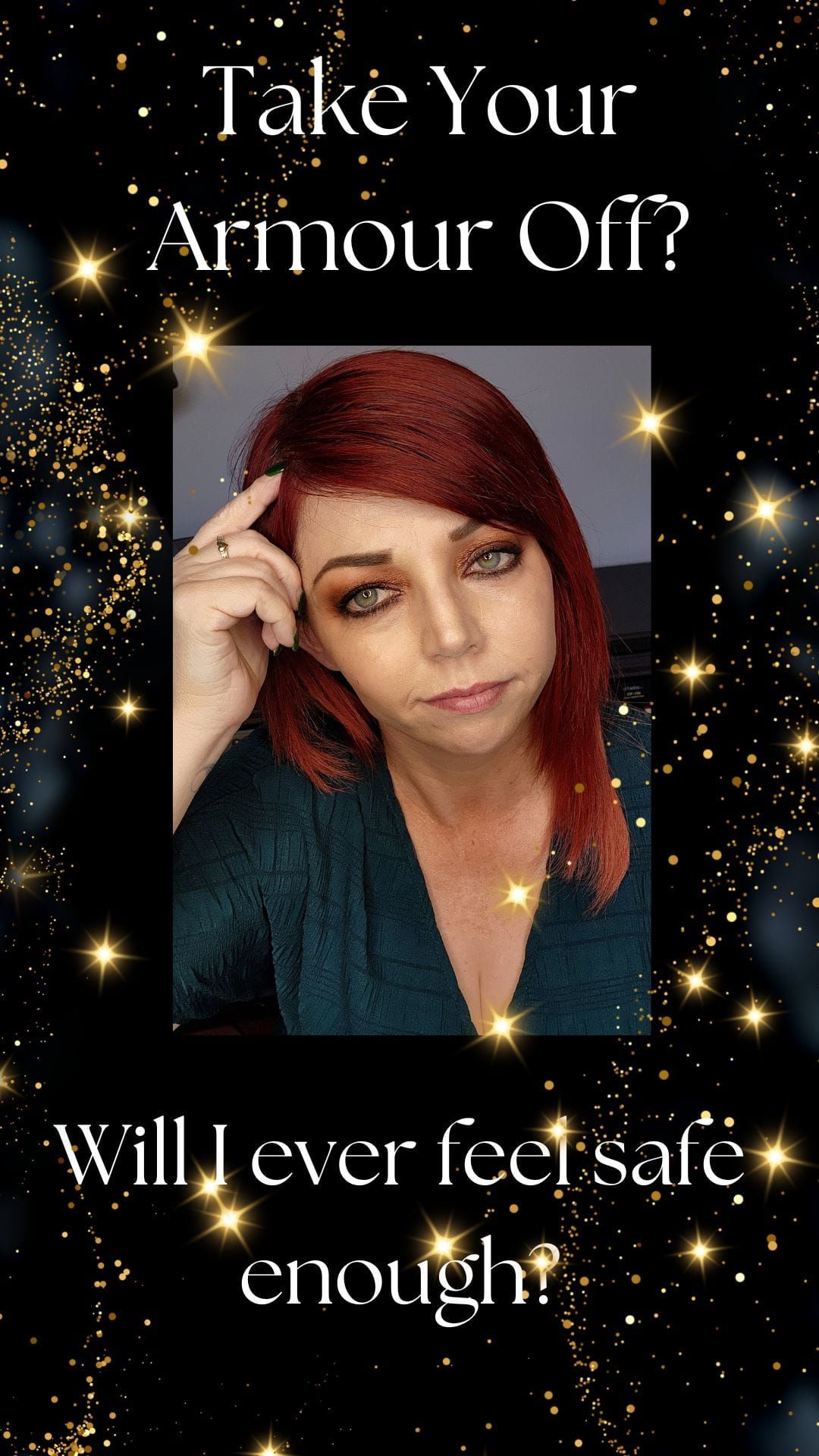
What does it mean to take your armour off?
Taking your emotional armour off means allowing yourself to be seen as you really are, without hiding behind defences that once protected you. It's about letting others in without fear or reservations.
Emotional armour develops for good reasons. If you've experienced betrayal, rejection, neglect, abuse, or repeated disappointment, your mind learns ways to protect you from being hurt again.
That armour might look like:
Keeping people at a distance.
Avoiding vulnerability.
Never asking for help.
Expecting the worst from others.
Staying constantly alert for signs you'll be hurt again.
Pretending you're "fine" when you're struggling.
The armour isn't bad—it probably helped you survive difficult experiences. The challenge is that what protects you from pain can also prevent you from experiencing closeness, trust, love, and genuine connection.
Taking your armour off doesn't mean becoming defenceless or trusting everyone. It means choosing, with safe people, to gradually let them see the real you:
Saying, "I'm scared," instead of pretending you're not.
Sharing your feelings rather than hiding them.
Allowing someone to support you.
Believing that not everyone will betray or reject you.
Setting healthy boundaries instead of building walls.
A good way to think about it is this:
Armour says: "No one can hurt me if I never let them close."
Healthy boundaries say: "I'll let people close, but I'll pay attention to whether they've earned my trust."
Betrayal, grief, and learning to feel safe again—taking your armour off isn't about removing all your protection at once. It's about replacing heavy armour with wise boundaries. Safety comes not from never being vulnerable, but from learning who has shown they deserve access to the vulnerable parts of you.
It's often a gradual process. Every time someone responds to your honesty with kindness, consistency, and respect, your nervous system learns that vulnerability doesn't always lead to danger. Over time, the armour becomes less necessary because you've learned to distinguish between people who are safe and people who are not.
Perhaps the hardest of taking your armour off isn't really about trusting other people first. It's about trusting yourself to recognize when someone is safe, and trusting yourself to walk away if they prove they aren't. That kind of self-trust creates a much deeper sense of safety than armour ever could.
My story
Look honestly my armour is still firmly on, I find these day's people are getting better at manipulating or maybe I'm trying so hard to not be jaded from my past and childhood that I miss some red flags that were possibly always there and so when I let me armour down even a bit, I get hurt.
I find myself distancing myself more and more from people, it's not what i want to do at all, but i just find each time i let me armour down even a little bit, I end up getting hurt. I'm also aware that distancing myself isn't fair on the good people in my life. At the moment I'm working on being ok with letting my armour down a little bit, being ok with being vulnerable. I'm always saying to others being vulnerable is strength not a weakness and I strongly believe this, but fear for me keeps getting the way. I know in my heart and my mind I am a survivor, I have been hurt, I have felt grief and I get through it, it's made me guarded and hypervigilant but I'm working on a lot of self talk and saying to myself don't block people out, its better to have had a friendship and loose the friendship to have never opened yourself up to it at all. There are so many good people in the world, don't let the bad people win, let the potential of good in. Easier said than done obviously but I am working on it everyday.
I get asked from time to time, why don't you open yourself up to the possibility of a relationship, i tell them, I'm simply not mentally or emotionally ready. I want to go build a relationship on a good foundation with healed bricks and atm my bricks are still a little broken. Clearly no one is ever fully healed, I will never be fully healed, I am not naïve to that but I want enough tools in my arsenal to be able to self regulate, not to shut down and to be able to handle whatever life throws at me. at the moment I tend to withdraw and hibernate, only coming out to work and the occasional poker game and that is not a healthy way to deal with things. Everyone needs alone time, self reflection but not when your hiding at home, getting things delivered, for fear of going to the supermarket, that's when you know things have to change. I'm lucky in the sense I'm quiet self aware and I'm realistic in where I am at, so I am able to better address the issues. Recently my therapist went on holiday's and I was going through a lot and I couldn't go to therapy, I literally had a panic attack but with the help of a couple of friends, I was able to talk things out, vent and regulate myself, I shouldn't need therapy to self regulate but on this occasion, I had a lot thrown at me in a space of 24 hours, so it was a little harder for me to rebalance and regulate but with time and help from friends and family I did. Obviously you guy's know I'm a big advocate for therapy and I know with continued therapy and working on my own, I will eventually be able to let my armour down and tackle everything and anything life throws at me. I'd like to just say take your armour off, but it's not that easy but don't give up, work on yourself everyday and bit by bit to those who have shown consistency in your life and show up with humbleness and love, take a chance and take your armour off, you may surprise even yourself with the happiness and peace that brings to your life.
The Season Theory (often called the Season, Reason, or Lifetime theory) The season theory is the idea that people come into our lives for different purposes and lengths of time. While it's widely shared in self-help books and on social media, it is a philosophical concept rather than a scientifically validated psychological theory.
It suggests that relationships fall into three broad categories:
1. A Season
These relationships are temporary. They enter your life during a particular chapter and often end when that chapter changes.
Examples include:
A friend who supports you through university.
A romantic partner who helps you grow after a difficult period.
A colleague you become close to during a specific job.
The purpose of a "season" is often growth, learning, or companionship during a particular time.
2. A Reason
These relationships have a specific purpose. Someone may appear in your life to teach you a lesson, challenge you, help you through a crisis, or inspire change.
They may be brief but have a lasting impact.
3. A Lifetime
These are the relationships that endure through different life stages. They are built on trust, commitment, mutual respect, and a willingness to grow together through both good times and hardships.
A balanced view.
The Season Theory can help people make sense of change and loss, but it also has limitations. It shouldn't be used to justify poor treatment or to avoid accountability. For example:
"They were only meant to be in my life for a season" can help someone accept an ending.
But it shouldn't become an excuse for betrayal, dishonesty, or refusing to work on a relationship.
Healthy relationships—whether they last a season or a lifetime—still require kindness, honesty, and accountability.
So If you think about the Season Theory, it may help with allowing you take your armour off a little by accepting you may get hurt but they may have just been in your life for a season and you will be ok.
I hope my blog has helped you in your quest to take your armour off, it's still a work in progress for me but i will get there.
Love and kindness Jody